
Inland Paratrooper Serial Numbers
SOLD FOR: $2,502.00
Make: Inland Division of General Motors
Model: M1 Carbine
Serial Number: 975101
Year of Manufacture: Barrel Dated October of 1943
Caliber: .30 Carbine
Action Type: Semi Auto, Fed by Detachable Magazine
Markings: There is no visible import mark. The top of the receiver is marked “U.S. CARBINE / CAL. 30 M1” on the front and “INLAND DIV. / 975101” on the rear. The barrel is marked “INLAND MFG. DIV. / GENERAL MOTORS / 10-43” and “P”. The right side of the rear sight is marked “JAO / 160060” (consistent with an Inland). The front sight is marked “N”. The left side of the butt stock is marked “O I” in the sling well (consistent with Inland). The right side of the butt stock is marked with the “crossed cannons” cartouche. The pistol grip base is marked with a “circle P”. The rear of the magazine is marked “U”.
Barrel Length: Approximately 18 Inches
Sights / Optics: The front sight is a blade set between two protective wings. The rear sight is a Type III.
Stock Configuration & Condition: The stock is a two piece hardwood with a pistol grip, sling well, metal barrel band with sling loop and metal butt plate. The top of the handguard has compression marks and small light scratches. There are scuff marks and small compression marks on the underside of the stock. There is a thin horizontal scratch on the right side that is 3 inches long. There is a ¾ inch thin compression mark on the underside of the butt stock. The LOP measures 13 1/8 inches from the front of the trigger to the back of the butt plate. The stock rates in about Fine overall condition.
Type of Finish: Military Applied Finish
Finish Originality: Original
Bore Condition: The bore is bright and the rifling is sharp. There is muzzle erosion near the muzzle. Our gauge measures muzzle erosion at 2.
Overall Condition: This rifle retains about 95% of its metal finish. There are small marks on the trigger guard, sling loop, butt plate and nose cap. There is light wear on the edge of the muzzle. There are light markings on the underside of the barrel that are smooth to the touch. The recoil plate shows wear. The screw heads show use. The markings are deep. Overall, this rifle rates in about Fine condition.
Mechanics: The action functions correctly. We have not fired this rifle.
Box, Paperwork& Accessories: This rifle comes with a green canvas sling that is unmarked. The metal tabs show light wear and light corrosion. It rates in about Very Good condition. The rifle comes with one 15 round magazine that shows wear from insertion and removal. It rates in about Very Good condition.
Our Assessment: This is another M1 made by Inland. This one has not been refinished and is in great shape. The “crossed cannons” cartouche on the stock and the stampings on the metal are all deep and well defined. This is a collectors rifle.
Inland Manufacturing Division of General Motors in World War Two
Dayton, OH
1918- 1989
Rest in Peace
This page updated 12-25-2020.
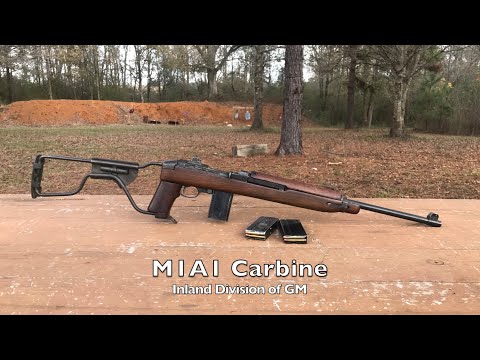
Inland M1A1 carbines in the first run of production were delivered between October 1942 and October 1943 and were numbered in teh 50,000 to 950,000 range. This example's serial number of 959,514 shows it was manufactured at the end of the serial range and matches the barrel manufacture date of 9/43.
- Inland Division Of General Motors M1 Carbine 'X' Series Serial Number Description: This Inland has the barrel date of 8-45. Reassembly required the use of new rivets. During WWII the M1A1 stocks and parts in the possession of Springfield Armory, whether made by Springfield or another manufacturer, were for use as replacements.
- The result was firearm history with Inland Manufacturing becoming one of the largest gun manufacturers in the US, producing nearly 3 million firearms in less than 5 years. The most notable of Inland’s firearm production was the.30 Caliber M1 carbine and the folding stock variant, the M1A1 Paratrooper model.
- Serial numbers of the Inland M1 carbine actions made during this period ranged from 70,000 - 950,000, and many of these actions were put into M1A1 stocks. Consistent features of the carbines in this range included a two-rivet handguard, narrow barrel band, flip rear sight, and push-button safety.
Inland Manufacturing Division was formed on January 6, 1923. General Motors formed the division to produce an automotive steering wheel consisting of an iron spoke covered with a glued-on wood veneer. That was a new technology at the time for producing this product. One of Inland's many contributions to the World War Two war effort were steering wheels for military trucks, along with control yokes for military aircraft. The division's original automotive steering wheel expanded to many other types of products. By the time of its 50th anniversary in 1973, the product line had expanded to 224 products produced by 7,000 employees.
Of special note is that when the new division started producing its new type steering wheels in 1923, it did so in the buildings previously occupied by the Dayton Wright Airplane Company. Inland also employed many of the same persons that during World War One built components for 3,500 DeHavilland DH-4 military aircraft assembled in Moraine, OH. The two buildings, called Plant 3 by the Dayton Wright Airplane Company, had originally been built by the Wright Brothers in 1910 and 1911.

When the original Inland complex was razed in the early 21st century, the original Wright Brothers' buildings were spared and are being preserved for future generations as the historic buildings that they are. They will be open to the public at some date in the future.
This is the original Wright Brothers factory at the former Inland Division location that was not razed with the rest of the buildings. It awaits restoration as a historic museum. Author's photo taken in February of 2015 and added 10-21-2015.
Inland Division of GM World War Two Production Statistics:
The .30 caliber Carbine:
The M1 carbine is most identifiable with the Inland Division. During World War Two it produced 1,984,189 M1 Carbines, 140,000 M1A1 Carbines, 500,000 M2 Carbines, and 811 M3(T3) Carbines.
The M1 carbine became a weapon of the US Armed Forces on October 22, 1941 and Inland Division was the first of ten manufacturers to receive an order one month later in November 1941. It was one of the only two companies still producing carbines when the war ended in 1945. Of the 6,110,730 carbines of all types built during the conflict, Inland made 2,625,000 or 43% of the total. Combined with the 517,212 that its sister GM Division Saginaw Steering Gear manufactured, General Motors produced 51% of all carbines made. Inland was the only manufacturer of the M1A1 folding stock, paratroop version, and was one of two companies that made the M2 version with selective fire. It also was one of two companies that made the M3(T3) carbine with infrared night sight and was the only supplier that made all four types of carbines. Inland Division of GM truly was the king of the carbine manufacturers!
Inland had the first and last series of serial numbers issued for the .30 caliber carbine.
1 to 5; 11 to 999,999; 2,912,520 to 3,212,519; 4,879,526 to 5,549,921; 6,219,689 to 6,449,867; 6,629,884 to 7,234,883; 7,369,661 to 8,069,660. Not all serial numbers were used.
Tank Shoes: 4,000,000 rubber and metal tank shoes were manufactured by Inland that were then assembled into tank tracks as of December 31, 1943, according to the 'The Inland Way at War Today' on page 18 below. With almost two more years of war left this would imply that many more were built before the end of the war.
Tank Tracks: 142,708 were built during the war. These would have been able to equip all of the 49,234 M4 Sherman tanks built during World War Two. That is a lot of tank tracks.
According to 'The Inland Way at War Today' on pages 16-19 below the Tank Tracks were used on light and medium tanks and tank destroyers. Pictured on page 16 is the M5 Stuart and its sister the M8 Three inch Howitzer Gun Carriage. The M4 Sherman was the main US medium tank of World War, while the M10 and M18 Tank destroyers were the two fully tracked types of this built during the war.
Gun sights and Shoulder rests for Oerlikon 20mm anti-aircraft cannons: Inland built 40,000 gun sights and 13,688 shoulder rests for this weapon. These weapons were used as a close range anti-aircraft weapon on U.S. Navy ships. 'The Inland Way at War Today' on page 22-23 below has more information.
M-1 Helmet Liners: By the end of December 1942, Inland manufactured 2,000,000 M1 helmet liners, but then stopped production due to a labor shortage in the Dayton area. See pages 24-26 in 'The Inland Way at War Today' for more. Also on page 52 below is a copy of the letter dated March 1943 from the War Department to Inland explaining the reason for pulling the business.
Clutches: 846,000 of all types. Pages 20 and 21 of 'The Inland Way at War Today' specifically talks about clutches and other parts for diesel tanks but gives no quantities. The Detroit Diesel Division of General Motors provided all of the diesel engines used in American built armor during World War Two. The engines went into 3,981 Canadian-built Valentine tanks, 913 M3 tanks, 8,053 M4A2 tanks, and 6,706 M10 tank destroyers, totaling 19,653 armored vehicles.
Pages 32-34 below discuss the Inland Clutch that was used in military truck and page 32 shows a drawing of a well-marked GMC 2-1/2 ton 6x6 truck. (Note that the artist missed putting the double set of wheels and tires on the rear axles. All GMC's built during the war had four wheels and tires on the rear axles.) During World War Two Chevrolet and GMC built 854,000 gasoline powered trucks for the war effort. Inland clutches were used extensively in these vehicles.
Truck Steering Wheels and Brake linings: Unknown numbers of these were built for Chevrolet and GMC trucks. See pages 35-36. During this time, Inland Division marketed its brake lining under the trade name Inlite. Steering wheels, like the clutches, were used on GMC and Chevrolet military trucks.
Rubber Parts: 68.8 million various rubber parts for military vehicles, aircraft, and ships. One of the major rubber products was aircraft sparkplug boots that prevented the ignition system from grounding out at high altitudes and low temperatures. See page 30 below for the whole story.
Fire Extinguisher Horns: See page 27 for the entire story of this important product for U.S. Navy ships during World War Two.
Inland Paratrooper Carbine Serial Numbers
On December 31, 1943, Inland had 6,339 employees producing 581 different products for the war effort in 756,193 square feet of factory space.
Inland received its first Army-Navy 'E' award on February 2, 1943. It received its second on August 20, 1943. It won three more awards at unknown dates for a total of five.
This Inland-built M-1 Carbine is on display at the Patton Museum at Fort Knox, KY. Inland built 2.6 million of these during the Second World War. Author's photo.
It is hard to see as the photo was taken through Plexiglas, but the name Inland is stamped into the receiver just ahead of the sight. Author's photo.
This Inland-built M1 Carbine is on display at Fort Macon State Park in North Carolina. Author's Photo added 1-14-2017.
The Inland stamp is easier to read than on the previous carbine and is serial number 210736. Author's Photo added 1-14-2017.
Inland Division of GM built 811 out of the 1,919 T3 infrared carbines during WWII.
This example of an M3 infrared Sniperscope is on display at the Museum of the USMC in Triangle, VA. Author's photo added 1-24-2017.
Inland made 4 million tank shoes for the war effort and then assembled them into 142,708 tank tracks. The pins that held the tracks together were manufactured by another GM Division in Dayton, the Delco Products Division. These are steel shoes and tracks on an M4 tank. Author's photo.
Inland also made rubber tank shoes as seen here. Author's photo.
This Fisher Body-built M4A3 tank was photographed in May 2008 by the author in the square in Bastogne, Belgium. It was hit by enemy fire on January 2, 1945. It went into combat with tracks made in Dayton, OH built by the Inland Manufacturing Division of General Motors. Author's photo added 1-7-2015.
Inland also assembled tracks for the M5 Stuart series of tanks during WWII. Author's photo added 1-7-2015.
This M10 Tank Destroyer photographed at the Bastogne Historical Center in Belgium in May 2008 had a Detroit Diesel engine for which Inland supplied the clutch. The tracks were also supplied by the Inland Division. Author's photo added 1-7-2015.
This page from the 1942 GM Annual Report shows Inland Division providing tank tracks for the M10 tank destroyer. Photo added 2-13-2014.
Inland Paratrooper Carbine Serial Numbers
Buick built the M18 tank destroyer with Inland tracks. Author's photo added 12-25-2020.

Cadillac manufactured this M8 self-propelled 75mm howitzer with Inland tracks. Author's photo added 12-25-2020.
Late in World War Two Cadillac built the M24 light tank with Inland tracks. Author's photo added 12-25-2020.
The Fisher Body Grand Blanc, MI tank plant built this M26 heavy tank with Inland tracks. Author's photo added 12-25-2020.
This is an authentic World War Two M-1 helmet. After making over two million of the helmet liners for this type helmet, the work was transferred to another location in 1943, due to a shortage of skilled labor in Dayton. Author's photo.
Inside the steel pot was a thermoset and fiber helmet liner as seen here. Inland made two million helmet liners during World War Two. Author's photo.
On March 5, 1944, Malvin Pike was wearing this M-1 helmet in Europe when it took the bullet strike show, here. The helmet liner cracked and imbedded in Mr. Pike's scalp, but the steel pot and liner kept him alive. The medic that worked on him sent the helmet and liner home for Mr. Pike, as he had thrown both in the trash. Note the rivet heads on the liner to hold the internal webbing in place. The liners were painted with a friction paint to help keep the steel pot from coming off of it. As seen at the USS Kidd Museum in Baton Rouge, LA. Author's photo.
This is a 20mm cannon, as seen on the USS Kidd in Baton Rouge, LA. During World War Two, Inland made the rubber shoulder pads for the gunner of these weapons. Author's photo.
Author's photo.
Pontiac built 20mm Oerlikon cannons for the U.S. Navy. This one on display shows both the Inland-built rubber shoulder pads and the large circular gun sight. Author's photo added 12-25-2020.
Inland supplied parts for Chevrolet 1-1/2 ton 4x4 trucks like this one seen at the 2013 Houston Airshow. Author's photo added 1-7-2015.
This is a Chevrolet World War Two Bomb Truck at the National Automotive and Truck Museum in Auburn, IN. Author's photo added 1-7-2015.
Chevrolet used four spoke steering wheels supplied by Inland. Author's photo added 1-7-2015.
Inland also supplied parts for GMC 2-1/2 ton 6x6 trucks like this one seen at the 2014 Columbus Aviation Day Open House. Author's photo added 1-7-2015.
Specifically, Inland supplied three spoke steering wheels like this one for the GM CCKW series of trucks. Author's photo.
Pictured here is a Pratt & Whitney R-2800 radial aircraft engine, which was used on such aircraft the F4U Corsair, the P-47 Thunderbolt, and the F6F Hellcat, to name a few. Inland sparkplug boots were instrumental in letting these fighters operate at high altitudes. Author's photo added 1-7-2015.
Inland designed the FP-45 .45 caliber 'Liberator Pistol' but the Guide Lamp Division built the weapon. It is on display at the Museum of the United States Air Force in Dayton, OH. Author's photo.
Author's photo.
This fire extinguisher was photographed by the author on the USS Kidd in Baton Rouge, LA. While this is not a World War Two fire extinguisher, due to fire regulations, it shows the type 'horn' that Inland made for the Navy. This project was considered to be more important than the helmet liner work which was transferred to another location. Inland got the critical jobs when engineering development was needed.
The next three photos show the now razed Home Avenue Inland plant in Dayton. Author's photo.
Author's photo.
Author's photo.
Post-World War Two Military Products:
In 1953 Inland was instrumental in the development of what was later designated the M60 machine gun. This is the final T161E3 version developed by Inland and was chambered for 7.62mm ammunition. The original T161 was chambered for 30.06 ammunition, as was the later T161E2. Inland produced twenty T1616E2s for testing which were converted to the E3 modification in 1955. Another 100 were also manufactured for testing and evaluation. At this point, another company took over the final development of Inland's work. It is not known why this happened. Author's photo added 12-10-2020 from the South Carolina Military Museum.
This is Inland T161E3 serial number 2 and is on display at the Virginia War Museum. Author's photo added 12-10-2020.
Author's photo added 12-10-2020.
'The Inland Way at War Today'
Added 1-7-2015.
Cover.
Page 1.
Page 2.
Page 3.
Page 4.
Page 5.
Page 6.
Page 7.
Page 8.
Page 9.
Page 10.
Page 11.
Page 12.
Page 13.
Page 14.
Page 15.
Page 16.
Page 17.

Page 18.
Page 19.
Page 20.
Page 21.
Page 22.

Page 23.
Page 24.
Page 25.
Page 26.
Page 27.
Aircraft do not have steering wheels; they have control yokes. Page 28.
Page 29.
Page 30.
Page 31.
GMC 6x6 trucks had dual tires on the rear axles during World War Two, not singles as show here. However, the artist was 60 years ahead of his time because the 21st Century U.S. military trucks now have single tires on the rears. Page 32.
GMC steering wheels were three spoke and Chevrolet four spoke. Page 33.
Page 34.
Page 35.
Page 36.
Page 37.
Page 38.
Page 39.
Page 40.
Page 41.
Page 42.
Page 43.
Page 44.
Page 45.
Page 46.
Page 47.
Page 48.
Page 49.
Page 50.
Page 51.
Page 52.
Page 53.
Page 54.
Page 55.
Page 56.
Page 57.
Page 58.
Page 59.